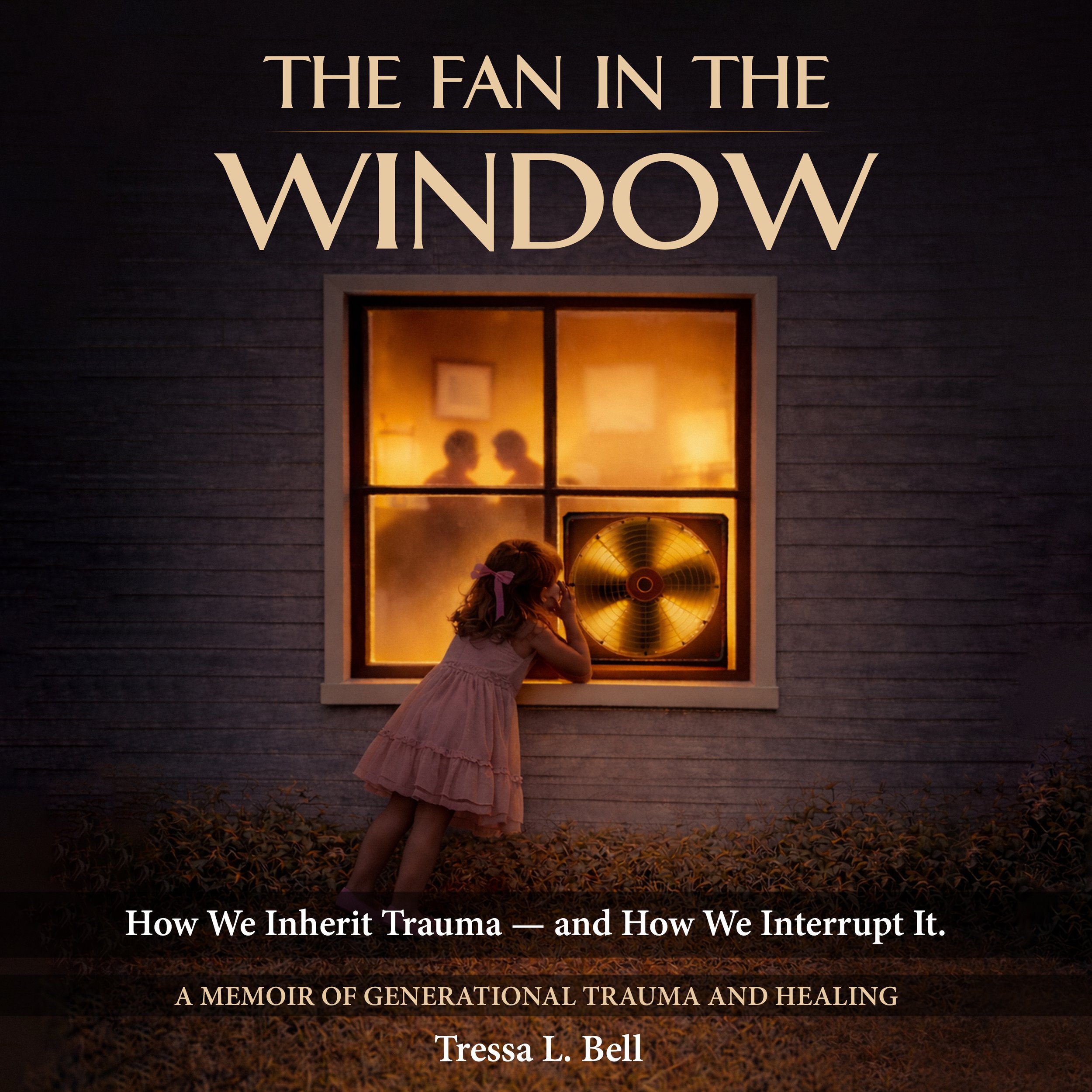
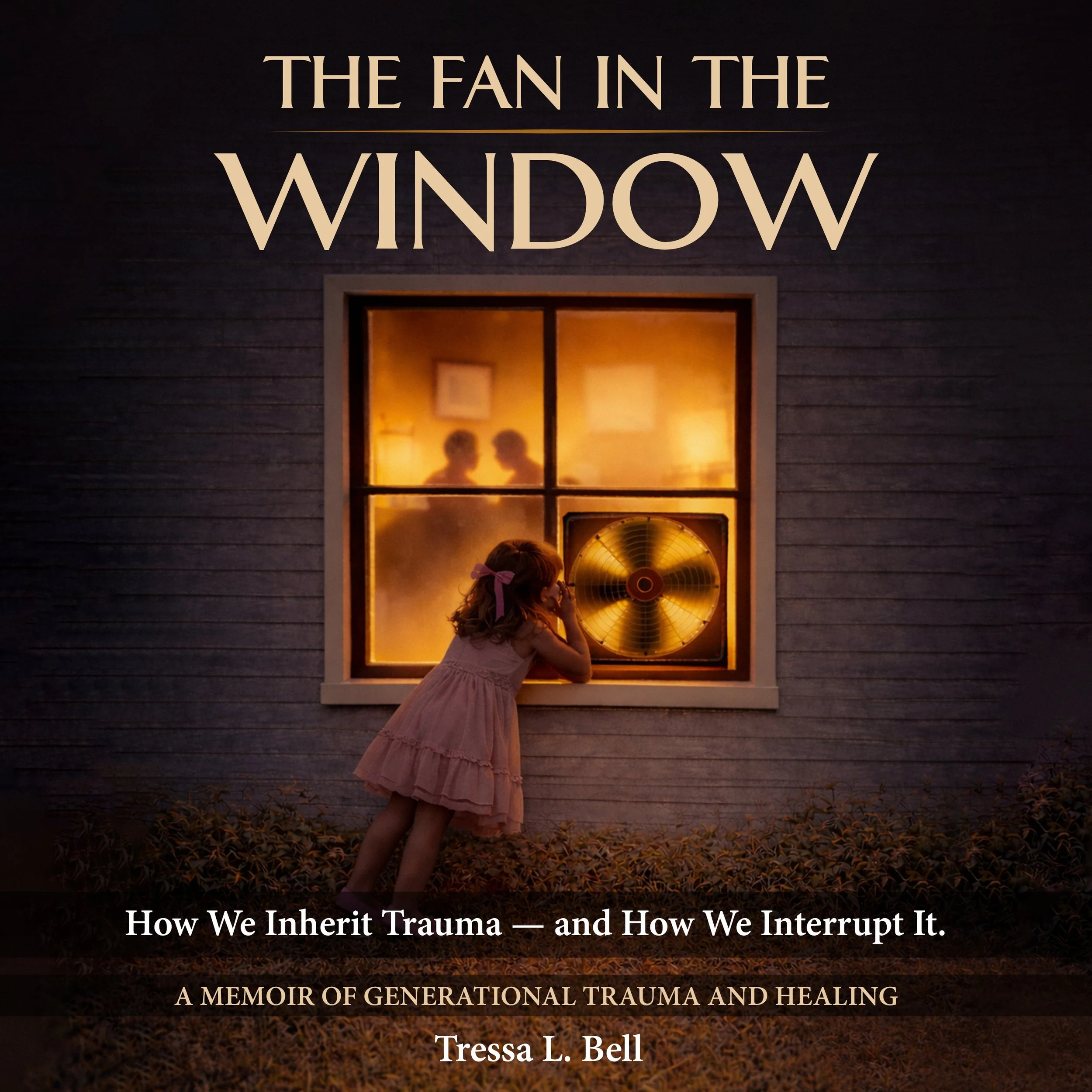
The Fan in the Window Podcast
There are things we carry that were never named.
Family rules. Ways of keeping the peace. Reactions we learned before we understood what we were responding to.
The Fan in the Window: Interrupting What We Inherit explores how those experiences follow us into our relationships, our parenting, and what we come to accept as normal.
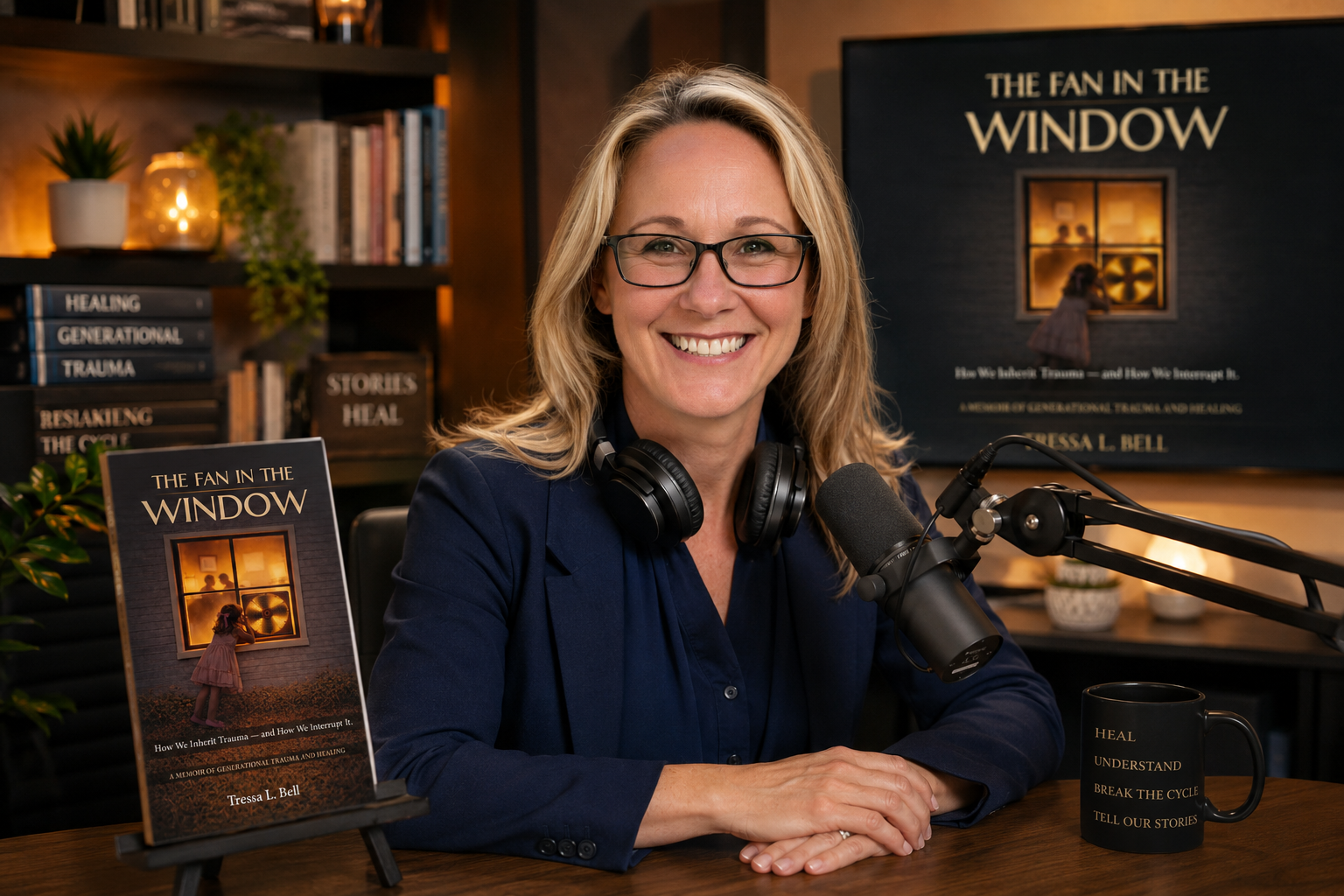
I’m Tressa L. Bell—a registered nurse, former forensic nurse examiner, author, and survivor of childhood abuse and domestic violence. I bring clinical understanding and lived experience to conversations about inherited trauma, nervous system responses, and the work of doing things differently.
Through solo episodes and guest conversations, we talk about family loyalty, accountability, domestic violence, and relationship safety. We explore why familiar doesn’t always mean safe, why leaving can be complicated, and what support, safety planning, and repair can look like.
Some episodes are personal. Some draw on research. Others make room for guests to share their experiences and expertise.
Throughout, we return to the patterns we inherited, how they affect us now, and what we want to stop passing on.
This didn’t start with you…but you can interrupt it.
New episodes every other Tuesday. Listen on Spotify, Apple Podcasts, or iHeartRadio, or watch on YouTube.
Season One-12 Episodes
Episode 1: The Book Wasn’t the End
Tressa Bell introduces her podcast, The Fan in the Window, about trauma, nervous systems, generational patterns, family systems, caregiving, and the work of healing and interruption. In the episode “The Book Wasn’t the End,” she describes finishing her manuscript and realizing that publicly naming patterns exposed how they still operate in her body, including over-functioning, bracing, and managing what isn’t hers. Drawing on Dr. Bruce Perry’s “bottom-up” brain development and the concept of implicit memory, she explains how childhood unpredictability and silence shape nervous systems before language, and shares that she experienced sexual abuse as a child, compounded by not being able to name it. She reflects on how hypervigilance can look like competence, including in nursing, and how reactive urgency can be passed to grandchildren. She offers a self-check question, a brief grounding exercise, and safety disclaimers and resources.
This podcast is for educational and reflective purposes only and does not constitute medical or mental health advice.
Listener discretion is encouraged.
Episode 2: You Can Leave and Still Be Dysregulated
Tressa Bell explains that leaving an unhealthy marriage or environment can create external safety but not immediate nervous system regulation, describing how, after leaving her marriage amid escalating conflict and self-harm threats, she remained hypervigilant and cycled between fight responses and dissociation. She distinguishes safety (external) from regulation (internal), noting that nervous systems follow learned patterns rather than logic, and cites Bruce Perry’s “old dirt road vs. new highway” metaphor to describe healing as building new pathways through repetition, not erasing old ones. Drawing from What Happened to You? by Oprah Winfrey and Bruce Perry, she emphasizes that regulation happens in relationships and through rhythm, movement, rituals, and community—protective factors often missing in modern isolated healing. She stresses repair over perfection, offers a brief grounding exercise, and previews the next episode on how chaos can feel familiar and inherited.
This podcast is for educational and reflective purposes only and does not constitute medical or mental health advice.
Listener discretion is encouraged.
Episode 3: When Chaos Feels Normal
Host Tressa Bell introduces The Fan in the Window, and explores how growing up around conflict, emotional unpredictability, and unresolved intensity can become “normal,” shaping adult templates for love, attraction, and resilience as conditioning rather than health. She explains that children prioritize attachment over accuracy, adapt to survive, and often can’t name dysfunction even when they perceive tension, power dynamics, and harm. Using a dinner-table memory where her mother cruelly told someone she hoped he would choke, Bell describes how normalization can trigger “management mode” instead of clarity and how lack of repair teaches that relationships are destabilizing and damaging. She discusses how the nervous system builds expectations, making familiar chaos feel more trustworthy than calm safety, invites listeners to notice “familiar vs. safe,” and closes with a brief grounding exercise, resources, and a preview of the next episode on what children carry.
This podcast is for educational and reflective purposes only and does not constitute medical or mental health advice.
Listener discretion is encouraged.
Episode 4: What Children Carry
Host Tressa Bell introduces The Fan in the Window: Interrupting What We Inherit and the episode “What Children Carry,” explaining that children absorb adult tension, tone, silence, and nervous-system shifts without needing explanations, often taking on anxiety and responsibility that are not theirs. She describes how kids learn love and conflict through what adults demonstrate, especially what happens after rupture, emphasizing that repair, accountability, and naming impact teach that relationships can bend without breaking. Drawing on personal moments with her grandkids and research referenced in What Happened to You? by Oprah Winfrey and Bruce Perry, she notes children experience repeated patterns as bodily expectations. Bell offers reflection questions about what listeners carried in childhood, leads a brief grounding practice, previews a next episode on family roles, and mentions her book The Fan in the Window releasing April 21.
This podcast is for educational and reflective purposes only and does not constitute medical or mental health advice.
Listener discretion is encouraged.
Episode 5: The Roles We Take On
Host Tressa Bell introduces The Fan in the Window: Interrupting What We Inherit and explores how children in chaotic, emotionally unpredictable homes adapt by organizing themselves into survival roles—responsible one, peacekeeper, protector, invisible one, performer, or mascot—often without realizing it. She connects this to family systems theory (Murray Bowen) and parentification, describing instrumental and emotional forms and noting research links between emotional parentification and adult anxiety, depression, emotional regulation difficulties, and boundary struggles. Bell shares a teenage memory of protecting a younger sister and explains, using Lindsey Gibson’s concept of the “Internalizer,” how these roles persist into adulthood and across relationships and work because the nervous system keeps running “old programs.” She observes different roles emerging in her own children, reflects on Bruce Perry and Oprah Winfrey’s “what happened to you” lens, and invites listeners to identify their role, practice awareness, and use grounding to begin interruption and repair. She mentions her book, The Fan in the Window, releasing on April 21.
This podcast is for educational and reflective purposes only and does not constitute medical or mental health advice.
Listener discretion is encouraged.
Episode 6: When You Change and the System Doesn't
Tressa Bell introduces The Fan in the Window: Interrupting What We Inherit and explores what happens when you step out of an inherited family or workplace role. Drawing on Murray Bowen’s Differentiation of Self and Family Projection Process, she explains how systems often push back—through anger, silence, questioning, or blame—to restore the old balance. She shares personal examples of being ignored by family and judged at work when she stopped always saying yes, and connects this to nervous system responses, including Steven Porges’s neuroception. Bell reframes guilt as a nervous system signal of unfamiliar change, not proof you’re wrong, and notes some relationships adapt while others can’t hold your growth. She offers reflection prompts, a brief grounding exercise, and previews a next episode on grieving lost roles while promoting her book.
This podcast is for educational and reflective purposes only and does not constitute medical or mental health advice.
Listener discretion is encouraged.
Episode 7: The Grief of Losing A Role
Tressa Bell introduces her podcast, The Fan in the Window: Interrupting What We Inherit, explaining how surgery created the stillness that led her to build a book, podcast, business, and platform rooted in her frustration that it took until age 50 to understand what happened to her at five. In this episode, “The Grief of Losing a Role,” she explores how family-system roles formed in chaos become identity, and why stepping out of them brings grief, confusion, and relief at once. Sharing a childhood moment of learning her father wasn’t biological, she connects role-based identity to survival, nervous systems, and generational patterns. She reflects on smoothing over her mother’s deathbed apology, defines forgiveness as the absence of anger, and offers grounding, journaling prompts, and the idea that healing is “the accumulation of Tuesdays,” with a preview of an upcoming episode about mothers’ apologies.
This podcast is for educational and reflective purposes only and does not constitute medical or mental health advice.
Listener discretion is encouraged.
Episode 8: When Mothers Apologize
Tressa Bell introduces a Mother’s Day episode of The Fan in the Window: Interrupting What We Inherit focused on the complexity of maternal relationships, including grief, estrangement, and mixed feelings, and clarifies the show is not therapy while providing crisis resources. She explores generational patterns of harm and distinguishes between an apology and a “real apology,” drawing on Harriet Lerner’s ideas: a real apology names the harm specifically, avoids “but” and explanations, doesn’t demand forgiveness or reassurance, allows time, and is supported by changed behavior. Bell shares an example of repeating a hurtful name with her daughter and returning to repair as part of interrupting inherited patterns. She also addresses ambiguous loss (Pauline Boss) for those whose mothers never apologized and offers reflective questions and a brief grounding practice about being seen and deserving repair.
This podcast is for educational and reflective purposes only and does not constitute medical or mental health advice.
Listener discretion is encouraged.
Episode 9: The Body Remembers What the Mind Forgets
You've done the work. The therapy. The reading. The healing. You've built language for what happened, found forgiveness, and made peace with things you couldn't change. And you still jump when a door slams. That is not a failure of healing. That is your nervous system doing the job it was assigned a very long time ago — and nobody told it the threat was over. In this episode, I go underneath the mind work and into the body. Because trauma is not stored as a story you can retrieve and resolve. It is stored as sensation. As muscle tension. As a heart that races before a single thought arrives. And until we understand that, we will keep wondering why we are still reacting to things that should no longer have power over us.
This podcast is for educational and reflective purposes only and does not constitute medical or mental health advice.
Listener discretion is encouraged.
Episode 10: Survival Mode Parenting
You loved your children. That has never been in question. But love and presence are not the same thing. And there are seasons of parenting where survival takes everything you have — leaving very little for the kind of presence your children needed and deserved. This episode is about that season. What it looks like from the inside. What your children are absorbing, even when you don't realize it. And what becomes possible when the crisis finally ends. This episode also includes a grounding practice and closes with what I believe is the most important reframe in all of this work: Your healing is their inheritance. Not the trauma. The healing. That is the interruption.
This podcast is for educational and reflective purposes only and does not constitute medical or mental health advice.
Listener discretion is encouraged.
Episode 11: The Illusion of Control
There is someone in your life you love deeply who is struggling. And you know things that could help. You can see the path forward. Every instinct you have says—do something. Fix it. You know how. And you have to let them find it themselves. That tension—between knowing and releasing, between loving and controlling—is what this episode is about. Not because control makes you a bad person. But because the need for control has a history. And understanding that history is the first step toward loosening the grip. This episode closes with a box breathing practice—because box breathing is itself an act of choosing what you can actually control. Your breath. The count. The pause. Nothing else. That is the whole metaphor of the episode lived in the body.
This podcast is for educational and reflective purposes only and does not constitute medical or mental health advice.
Listener discretion is encouraged.
Episode 12: What Healing Actually Looks Like: Interrupting What We Inherit
This is the season finale. And I want to be honest with you from the start. I do not have a tidy ending. I do not have a before-and-after story with a clean resolution and a lesson neatly wrapped. What I have is a direction. A long way traveled. And the deep conviction that there is no finish line — and that is not a failure. That is the truth. Twelve episodes. Twelve conversations about the roles we take on, the grief we carry, the apologies we give and receive, the bodies that remember what our minds try to forget, the survival mode we parent from, and the control we grip when we are afraid.
This podcast is for educational and reflective purposes only and does not constitute medical or mental health advice.
Listener discretion is encouraged.
Season Two
Episode 1: Where We Go From Here
Most of us didn’t learn how to be in a relationship. We learned how to survive inside one.
Season 2 opens with a solo episode—and it goes somewhere personal.
Tressa shares what conflict used to look like in her own relationships: the fawning, the silence, the collected resentment, the flooding, the cruelty that came out without warning, and the leaving. And then the moment that broke her—seeing fear in her children’s faces and recognizing it. Because she had worn that face herself.
This episode is about what happens between understanding your patterns and actually changing them. If you’ve done the work—the therapy, the reading, the 2 a.m. conversations with yourself—and you’re still ending up in the same places, this episode is for you.
It’s not a character flaw. It’s a nervous system doing exactly what it learned. And nervous systems can learn something different.
Listener discretion is encouraged.
Episode 2: The Version of Love We Inherited
There’s a version of love that jumps in front of everything so your child never has to feel it. And there’s a version that learns to hang back, to ask what they need instead of deciding, to trust that the feeling won’t break them.
Most of us were never shown the second one. So, we defaulted to the first one—and called it love. Because it was. It was also something we inherited.
Today’s guests are two people who figured out the difference—and are doing it in real time, inside their own relationship, in front of three children who are watching everything.
Lavinia Brown is a trauma-informed psychodynamic coach who supports mothers in becoming the conscious parents and connected partners they want to be through healing their inner child. She holds a master’s from Oxford University and is a certified clinical trauma specialist through the Arizona Trauma Institute.
Andrew Lynn is a trauma-informed coach and Lavinia’s partner in both life and work. Together they co-host Becoming Untriggered—a podcast in the top 5% globally.
Listener discretion is encouraged.
Episode 3: Before I Had Words
There is a version of healing that happens alone. In therapy.In journals. In the 2 a.m. conversations you have with yourself when something finally clicks.
And then you go back to your life. Back to the people youlove. And someone does something ordinary—and everything you understood at 2 a.m. disappears. And you are back in the pattern. Again.
That gap—between what you understand and what you can actually do in the moment with another person—is what this episode is about.
Because understanding is not the same as changing. And I learned that the hard way, inside my marriage, before I had the words to explain what was happening to me or to ask for what I needed.
Listener discretion is encouraged.
Episode 4: Before the Damage Is Done
Most of what we talk about on this show is what happens after. After you recognize the pattern. After the damage has already moved through your family line.
But what happens when you see it coming?
Dr. Rondalyn Whitney has spent her career studying exactly what protects children from the harm trauma causes. When she was widowed in 2020—her husband Bill killed instantly in a car accident—she didn’t just grieve. She applied everything she knew to protect her son Alex before the damage could take hold.
That is not a story about healing after the fact. That is a story about interruption before the damage is done.
Listener discretion is encouraged.
Episode 5: What Familiar Feels Like
Have you ever looked at a relationship and thought—how did I end up here again?
Not the same person. But the same feeling. The same dynamic. The same patterns playing out in a slightly different set of circumstances.
You were not choosing wrong. Your nervous system was choosing familiar. And familiar and safe are not the same thing—but they feel that way when you grew up in a house where familiar meant surviving.
This episode is about attachment. What it is, where it comes from, how it shapes every relationship you walk into as an adult—and what it means that you can interrupt it.
Listener discretion is encouraged.
Episode 6: What Happened To You?
There is a question that changed the way I think about children.
Not what’s wrong with you.
What happened to you.
Those are two very different questions. And the one you ask determines everything—what you see, what you miss, what you do next, and what the child in front of you learns about whether they are worth understanding.
Today’s guest works with children and families every single day inside a school building in Frederick, Maryland—where she sees what trauma actually looks like in the hallways, the classrooms, and the counselor’s office. This conversation is for every parent who has ever wondered what is really going on with their child. And for every adult who was once that child.
Listener discretion is encouraged.
Episode 7: Daddy Issues and Mommy Issues: How Childhood Relationships Affect Adult Love
“Daddy issues.” “Mommy issues.” People use those phrases as if they explain someone. They rarely picture the child standing at the door, waiting for a parent to say, “I love you,” back.
In this solo episode of The Fan in the Window: Interrupting What We Inherit, Tressa Bell explores how childhood relationships can shape adult love, conflict, approval-seeking, and the way we respond to someone else’s disappointment.
Drawing from her experiences with her biological and adoptive fathers, Tressa talks about loving a parent who also hurt you, why finding an absent parent doesn’t automatically create a sense of belonging, and how fear of spanking taught her to hide things rather than feel safe telling the truth.
She also shares experiences her daughters have given her permission to discuss—and considers what accountability asks of us when our own children tell us something we don’t want to hear.
The conversation includes research on physical punishment, parental warmth, and recovery after relationship conflict, along with a practical example of the Interruption Model™: Notice, Name, Regulate, Interrupt, Repair, Repeat.
Listener discretion is encouraged.