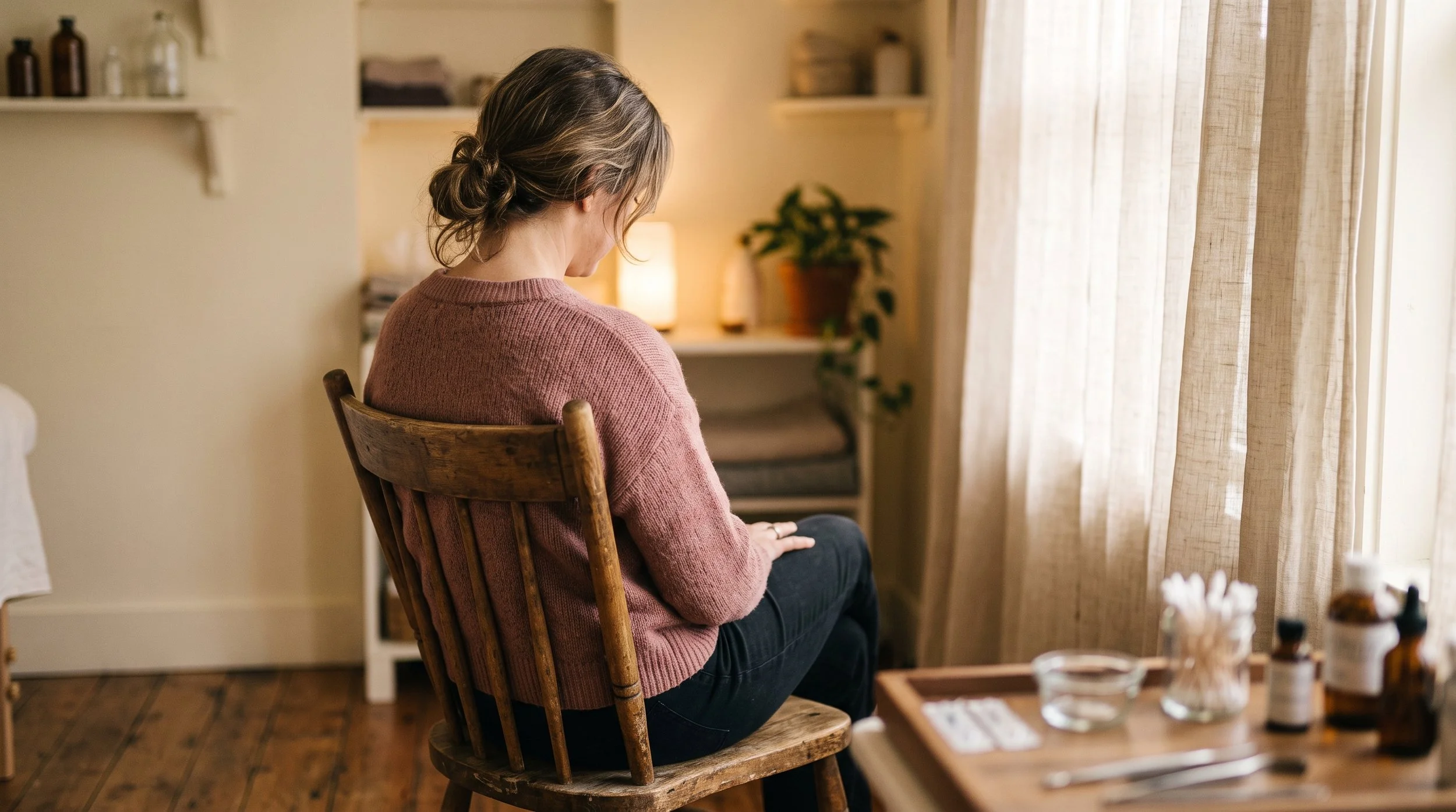
The Chair, the Panic, and the Pause
I'm sitting alone in the room. Needles already in, nobody touching me, nothing wrong—and out of nowhere, my body reacts like it's in danger. This is what happened when I had my first acupuncture appointment, and the three relationships it made me look at differently.
What a first acupuncture appointment taught me about my body, a stranger I'd just trusted, and the truth I didn't tell him
I'm sitting in a chair, alone in the room. Needles already in—my neck, my shoulders, right where I'd been carrying pain that day. He'd stepped out so I could relax. Checked in a few minutes later—I was fine. He left again.
And then, alone in that room, out of nowhere, pain flares in my shoulder blade—and right behind it, panic.
Get him back in here. Right now. Tell him to stop.
Nothing was wrong. I'd chosen this. I was safe. Nobody was even touching me in that moment. So why did my body suddenly feel like it needed to yell for help?
That's what I want to walk through with you today—because it turned out to touch three relationships I didn't expect it to: my relationship with my own body, my relationship with someone new I was trusting with my care, and one I'm still sitting with—my relationship with telling the truth about my own experience.
What Actually Happened
I won a mini acupuncture session. First time ever. Curious, a little nervous, genuinely open to it.
He had me sit in a chair, focused on my neck and shoulders—which, if you know me, is exactly where I hold everything. I'd actually been in pain there that day. Every deadline, every hard conversation, every year of holding it together lives right there.
The needles themselves were fine. Some I didn't feel at all. A couple gave me a little zing—nothing close to painful.
He placed them, then stepped out so I could relax. A few minutes in, he checked on me. I told him I was okay. And right then, I was.
He left again. And it was in that stretch—alone, still, nobody touching me—that pain started up in my shoulder blade. And that's when it happened. Not a physical reaction to the pain itself. An emotional one, layered right on top of it. Anxiety, flooding in fast, almost out of nowhere. That urge to call out, to end it, to get someone back in the room.
I want to sit here for a second, because I think a lot of you will recognize this: the moment your body reacts like it's in danger, and your mind is standing there going, wait—nothing is actually wrong.
That gap—between what your body is doing and what your circumstances actually are—isn't a malfunction. It's a trauma response doing exactly what it was built to do. Just at the wrong time.
Why It Happened When I Was Alone, Not When He Was in the Room
Here's what's interesting, and it's the part I keep coming back to: the panic didn't hit while he was in the room, and it didn't hit while anyone was touching me. It hit when I was alone, still, with pain I couldn't immediately explain and no one there to check with.
That reframes what actually happened. This wasn't about someone else's hands on me. It was about being alone with an unexplained sensation in my body—which is its own well-worn trigger for a lot of trauma survivors. Isolation plus unexplained physical sensation is a combination the nervous system can read as danger, even in a room you walked into safely, on purpose, minutes earlier.
Your nervous system doesn't check a calendar. It doesn't know it's years later and you're fine. It pattern-matches on sensation and circumstance, not on facts. That's what we mean when we talk about the body keeping score—it's not poetic, it's literal.
There's real, growing research on acupuncture's effect on the parasympathetic nervous system—some evidence it can support vagal tone and shift the body out of fight-or-flight. It's not fully mapped out, and I won't oversell it as a cure-all. But as one modality in a toolkit for people doing this work, it's worth having on your radar.
The Part I'm Still Turning Over
When he'd checked in earlier and asked how I was, I said I was okay—and in that moment, I was. But the panic came after, once he was gone again, and I never called him back in or told him afterward what had happened.
I don't fully know why. Maybe it was that reflex a lot of us carry—the automatic instinct to manage things quietly rather than interrupt someone doing us a kindness. Maybe it felt easier to ride it out alone than to name it to someone I'd just met. Maybe by the time it passed, it genuinely felt over and not worth bringing up.
I'm still sitting with that one. If you know that reflex—the one where you quietly handle it instead of telling the person nearby what's actually happening—you know exactly what I mean.
What I Actually Did
This is the part I want you to be able to use, not just relate to. It's the Interruption Model™ in real time—the same framework I teach on the podcast, playing out in my own body.
Notice. I didn't push the feeling away or pretend it wasn't there. I let myself clock it: something just shifted. This is bigger than the moment calls for.
Name. Silently, I named it. This is anxiety. This is panic starting. Naming it moves the experience from your body's alarm system into your thinking brain. It gives you a tiny bit of distance from it.
Regulate. I used slow, deep breaths. And I talked to myself, internally, the way you'd talk to someone you were trying to ground: I'm in the moment. I'm here. I'm okay. I'm safe.
I didn't call out. I didn't ask him to come back in. I rode it out alone, and it passed.
I want to be clear about something—this isn't about toughing it out or overriding your body. If you need to speak up, if you need someone with you, that instinct is valid too, and you should honor it. What I'm describing is a tool for when you want to stay present and need a way back to yourself. Not a rule that you always have to push through alone.
What's True Now
My range of motion improved. My neck and shoulders—the place I hold it all—genuinely felt looser. More relaxed than they've been in a while.
He also mentioned qi gong—short videos his trainer put together, seven minutes each, that he's found helpful. I haven't tried them yet, but I want to. I'll let you know how it goes.
But honestly, the thing I'm proudest of isn't the acupuncture, and it's not even the qi gong lead. It's that I caught myself. Alone, in real time, mid-panic, I used the exact framework I teach, and it worked—on me.
Three Questions, If You're Doing This Work Too
If you're in the middle of your own inherited-trauma work, your own nervous-system work, I want you to take this as permission, not a prescription.
Permission to try a modality like acupuncture, or qi gong, or whatever's in front of you—and know that if something old comes up when you're alone with it, that doesn't mean you failed or that the modality is wrong for you.
Three questions to sit with this week, one for each relationship this touched:
Where in your body have you been avoiding stillness?
When something happens with someone new who's caring for you, do you tell them the truth of your experience, or do you manage it quietly instead?
And when you catch yourself doing the second one—can you ask yourself why, without judgment, the way I'm still asking myself right now?
If this resonated, I talk about this work more deeply in my book, The Fan in the Window—how our nervous systems carry what we inherit, and how we begin interrupting those patterns for the next generation. Available now on Amazon.
Coming Soon: You Can Interrupt It: A Practical Guide for the Parent Who Inherited Trauma and Swore They'd Do It Differently—if the memoir gave you the story, this book gives you the roadmap. Built around the Interruption Model™—practical tools for doing the work one pattern at a time. Stay connected at thefaninthewindow.com for updates.
Want a place to start putting this into practice today? Grab The First Interruption Kit at thefaninthewindow.com/start.
This piece discusses trauma responses and panic. If anything here brings up strong feelings or memories, please take care of yourself and reach out for support. In the U.S., you can call or text 988 to reach the Suicide and Crisis Lifeline—free, confidential, 24/7. Outside the U.S., international crisis resources are available at findahelpline.com. You do not have to navigate this alone.
This didn't start with you…but you can interrupt it. 🪟