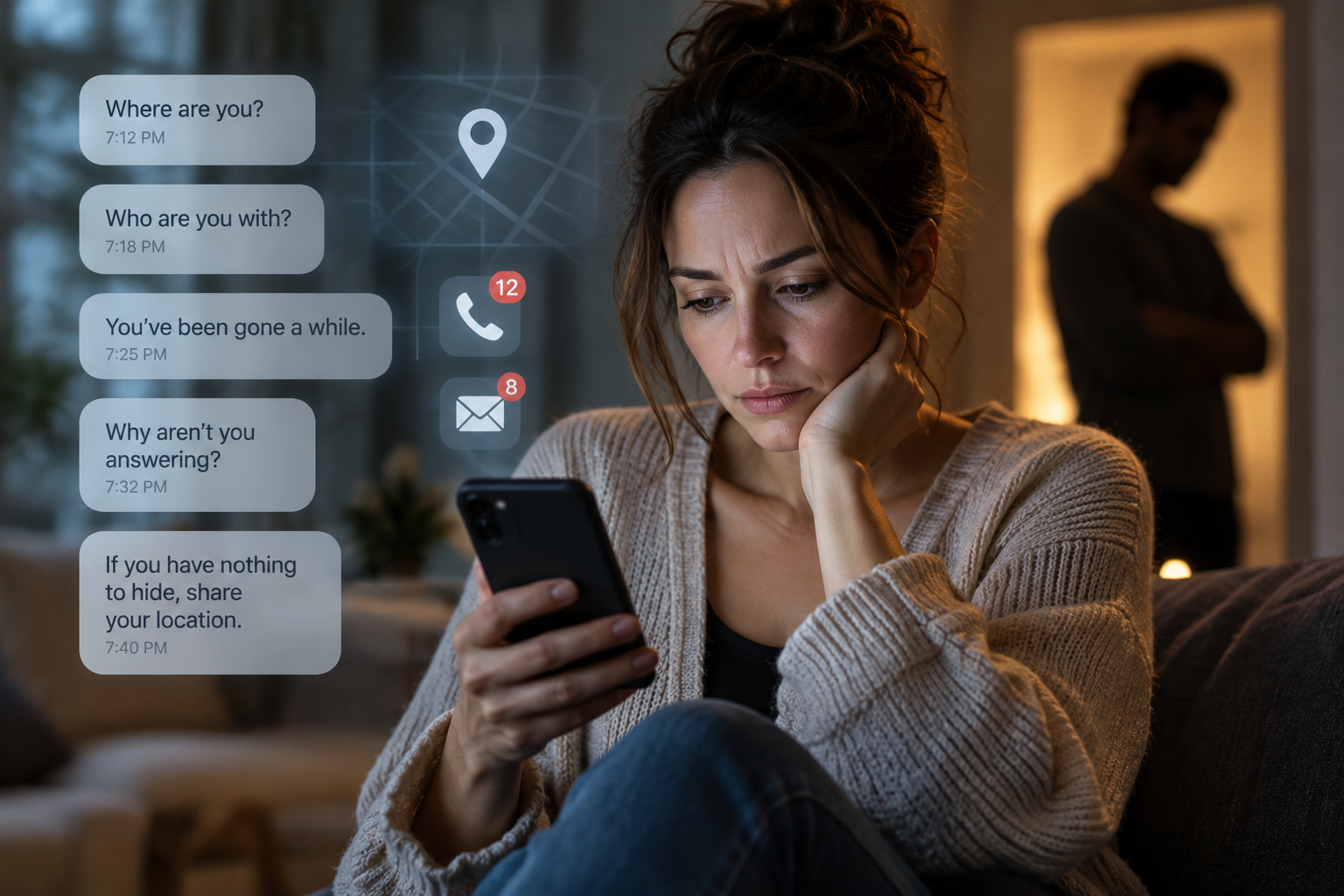
When Checking on You Becomes Monitoring You: The Difference Between Care and Control
They say they're just checking on you. So why do you feel like you're being watched?
There's a difference between someone wanting to know you made it home safely and someone demanding to know where you are, who you're with, and why you didn't answer your phone. Controlling behavior doesn't always start with threats. Sometimes it starts with what looks like love and concern.
Here's how to recognize when checking in crosses the line into monitoring, coercive control, and emotional abuse.
When does concern cross the line into controlling behavior? Sometimes the difference is harder to recognize than we think.
“Text me when you get there.”
“Let me know when you're on your way home.”
“Who are you going with?”
Those are pretty ordinary things to say in a relationship. Most of us have said them, and most of us have heard them.
And there's nothing inherently wrong with any of them.
But what happens when “text me when you get there” turns into twenty messages because you didn't respond fast enough? Or when sharing your location stops being a convenience and becomes something you're expected to do?
What happens when someone says they're worried about your safety, but you find yourself constantly explaining where you've been, who you've talked to, and why you didn't answer your phone?
That's where the conversation gets more complicated.
Because sometimes controlling behavior doesn't look like control in the beginning.
Sometimes it looks like someone who really, really cares.
When Concern Starts Coming With Conditions
Healthy relationships involve concern for each other's well-being. That's normal.
But there's a difference between wanting to know someone arrived safely and expecting them to account for every minute of their day.
Consider these examples.
Concern sounds like:
“Let me know when you get home so I know you're safe.”
“Have fun with your friends!”
“I was worried when I couldn't reach you. Is everything okay?”
Control might sound like:
“Why didn't you answer me immediately?”
“If you have nothing to hide, why won't you share your location?”
“I don't understand why you need to go out without me.”
“You know how much I worry. Why would you do that to me?”
The words aren't always the deciding factor. Context matters.
What happens when you say no? What happens when you don't respond? Can you disagree without being punished for it?
Those questions often tell us more than the original request.
Technology Has Made Monitoring Easier Than Ever
We carry devices that can tell other people where we are, when we're active, and sometimes who we're communicating with.
Location sharing, read receipts, social media activity, and shared accounts can all be useful.
They can also become tools of control.
Someone might insist on having access to your passwords because “couples shouldn't have secrets.”
They might question why you were online but didn't respond to their message.
They might repeatedly check your location and demand an explanation when you stop somewhere unexpectedly.
Or they might become angry when you turn off a feature that was supposedly voluntary.
Sharing information isn't automatically a problem. Being afraid of what will happen if you stop sharing it is.
And that distinction matters.
Why It Can Be Difficult to Recognize
One reason controlling behavior can be difficult to identify is that it doesn't always begin with obvious threats.
It may start with small requests that seem reasonable.
Maybe your partner wants you to call when you arrive somewhere. Then they want you to call when you leave. Eventually, they expect updates throughout the day.
At some point, you may notice that you're checking your phone constantly, not because you want to communicate, but because you're worried about the reaction if you don't.
You might start changing your behavior to avoid an argument.
You leave an event early. You stop visiting certain friends. You explain innocent interactions before anyone asks.
And because those changes happen gradually, you may not recognize how much your world has gotten smaller.
This is one way coercive control can operate.
Coercive control involves patterns of behavior used to restrict another person's independence and freedom. It can include intimidation, isolation, surveillance, financial restrictions, threats, and emotional manipulation.
It doesn't always involve physical violence.
And a relationship doesn't have to become physically violent for controlling behavior to cause harm.
What If You've Experienced Trauma Before?
This is where generational trauma and our earlier experiences can become part of the conversation.
If you grew up in an environment where someone else's anger determined whether the day would be peaceful, you may have learned to pay close attention to people's moods.
You may have learned that explaining yourself, anticipating reactions, or keeping someone happy helped prevent conflict.
Those responses can carry into adulthood.
So when a partner demands constant updates, you might not immediately think, “This isn't okay.”
You might think, “I should have remembered to text.”
Or, “It's easier to just tell them where I'm going.”
Or even, “They're only acting this way because they love me.”
None of that means everyone with a trauma history will experience controlling relationships. And it certainly doesn't mean someone causes another person's controlling behavior.
But understanding what we've learned about relationships can help us recognize patterns that might otherwise feel normal.
Sometimes the behaviors we learned to keep the peace make it harder to notice when we're being asked to surrender our independence.
Privacy Is Not the Same as Secrecy
This is something I wish more people understood.
Being in a relationship doesn't mean giving up every expectation of privacy.
You can love someone and still have private conversations.
You can be committed to someone and still spend time with friends independently.
You can choose not to share your location every minute of the day.
And you can have boundaries without those boundaries being evidence that you're hiding something.
Trust isn't established by giving someone unlimited access to your life.
A relationship built on trust allows room for two separate people to exist within it.
Of course, couples can mutually agree to share passwords, locations, or other information. The important questions are whether those agreements are genuinely voluntary, whether both people have a voice, and whether either person can change their mind without fear.
Pay Attention to What Happens When You Set a Boundary
One of the clearest ways to understand a concerning pattern is to look at how someone responds to a reasonable boundary.
Imagine saying:
“I don't want to share my location all the time anymore.”
A partner might feel disappointed or want to talk about why. People have feelings, and not every disagreement is abusive.
But there's a meaningful difference between having a conversation and being threatened, intimidated, repeatedly interrogated, or punished until you give in.
The same applies to answering messages, spending time with friends, or maintaining personal privacy.
A boundary doesn't have to be welcomed enthusiastically to be respected.
And if you're afraid to set a boundary because of what might happen afterward, that fear deserves attention.
If you believe setting a boundary could put you in danger, you don't need to test the person's reaction to prove that the behavior is controlling.
Your safety comes first.
When Monitoring Becomes a Safety Concern
Repeated surveillance, threats, stalking, and restrictions on someone's movement can be serious warning signs.
If someone is monitoring your phone, accounts, or location without your consent, getting help may require additional precautions.
For example, suddenly disabling location sharing or changing passwords can sometimes alert a controlling partner and increase risk.
A domestic violence advocate can help you think through safer options based on your circumstances.
You don't have to wait until physical violence occurs to ask questions or seek support.
And you don't have to be certain that what you're experiencing qualifies as abuse before talking to someone.
So, How Do You Tell the Difference Between Care and Control?
Look at the pattern rather than one isolated interaction.
Does the other person respect your independence?
Can you make ordinary decisions without anticipating anger or retaliation?
Can you spend time with other people without being interrogated afterward?
Can you decline to share information without being accused of disloyalty?
Do you feel comfortable communicating, or do you feel obligated to constantly prove where you are and what you're doing?
No single question can define an entire relationship.
But together, these questions can help you recognize whether concern is becoming a way to restrict your freedom.
And sometimes recognizing that pattern is the beginning of understanding something you've been struggling to put into words.
A Final Thought
I don't believe we should treat every disagreement, insecurity, or request for reassurance as abuse. Relationships are more complicated than that.
But I also don't believe we should dismiss controlling behavior simply because someone says it's coming from a place of love.
Love doesn't require constant surveillance.
Concern shouldn't leave someone feeling afraid to put down their phone.
And trust shouldn't depend on surrendering every bit of privacy.
If you've spent years believing that keeping someone else reassured is your responsibility, it can take time to recognize when reassurance has become an expectation you can't safely refuse.
That recognition matters.
Because understanding the difference between care and control can change how we understand our relationships, our boundaries, and the patterns we've learned along the way.
Need Support?
If you're concerned about controlling behavior, monitoring, or abuse in a relationship, confidential support is available through the National Domestic Violence Hotline.
Call 800-799-SAFE (7233), text START to 88788, or visit thehotline.org.
If your device or internet activity may be monitored, consider using a safer device to seek help.
About the Author
Tressa L. Bell, MBA, BSN, RN, is a registered nurse with forensic nurse examiner experience, author, podcast host, and speaker. Through The Fan in the Window, she explores generational trauma, domestic violence, relationships, and the patterns we inherit and can learn to interrupt.
She is the author of The Fan in the Window: How We Inherit Trauma and How We Interrupt It and You Can Interrupt It.
Learn more at thefaninthewindow.com.
This article is for educational purposes and does not replace individualized medical, mental health, or legal advice.

Am I Becoming My Mother? Why It Feels That Way—and How to Interrupt It
You swore you'd be different. Then you heard yourself say it—and went still.
You’re in the car. Your kid says something, does something, and before you can stop it, a voice comes out of you. The tone. The words. Maybe the exact phrase you swore you would never say. For a second, your stomach drops—because you don’t sound like you. You sound like her.
If you’ve had that moment and then spent the rest of the day sick about it, you are not a bad parent. You are a parent who inherited something—and just caught it happening in real time.
Why it feels like you’re turning into your mother
The fear underneath “am I becoming my mother?” is usually not really about your mother. It’s a quieter, more frightening question: Is this just who I am? Is it already too late?
It isn’t. But to believe that, you have to understand what’s actually happening—because it is not what you think.
What’s actually happening in your body
What you’re describing isn’t a character flaw. It’s a nervous system doing exactly what it was trained to do.
Here’s the plain version, from a nurse: when you grow up in a home where you have to stay alert—reading moods, bracing for the next outburst, keeping the peace—your body learns that the world is not safe. It wires itself for speed. It learns to react before you can think, because back then, thinking was too slow to protect you.
So years later, when your child slams a door or whines in that particular pitch, your body doesn’t check the calendar. It doesn’t know you’re grown and safe now. It runs the old program—the fast one—and the reaction is out of your mouth before the reasoning part of your brain has even arrived.
That’s not weakness. That’s a body that adapted to survive. The reactions that scare you now were once the very things that kept you safe.
It’s not too late—and here’s why
A pattern you can name is a pattern you can change. You cannot interrupt something you cannot see. The fact that you noticed—that you felt the drop in your stomach, that you’re reading this right now—means you’ve already done the first and hardest part. You saw it.
Most people who are truly repeating a pattern never feel sick about it. Your discomfort is not proof that you’re becoming her. It’s proof that some part of you is already refusing to.
How to interrupt it: one small step this week
You don’t break this in one heroic moment. You interrupt it, one small choice at a time. Here’s one to try this week.
The next time you feel the heat rise—the jaw tighten, the voice climb—name it silently, just to yourself: “That’s the old wiring. Not now.” Then do one small thing to slow your body before you respond. One breath out, longer than the breath in. A step back. A hand flat on the counter.
You will not do this perfectly. You’ll catch it on the tenth try, not the first. That isn’t failure—that’s how it works. Cycle-breaking is repetition, not perfection.
When you miss it: the repair that changes everything
You will miss it. And when you do, you get to do the thing your mother may never have done—you go back. “I was sharp with you earlier, and that wasn’t about you. I’m sorry.”
That single sentence, said by you, to your child, is the interruption. It doesn’t erase the moment. It teaches them something most of us were never taught: that love and repair can live in the same house. That a person can lose it and come back. You are not just stopping an old pattern—you’re handing your child a new one.
You are not becoming your mother
You are becoming the person who finally noticed the pattern. And that person—the one who feels the drop, who reads the article, who tries the breath, who goes back and repairs—is the one who gets to end it.
If anything here brings up strong feelings, please take care of yourself. In the U.S., you can call or text 988 anytime—free and confidential. Outside the U.S.: findahelpline.com. You don’t have to navigate this alone.
If you want a place to begin, I made one.
The First Interruption is a free starter kit—what your nervous system learned, the six-step Interruption Model, and one small interruption to try this week. No cost, no catch.
Get it free: thefaninthewindow.com/start
This didn’t start with you…but you can interrupt it. 🪟